
The four most common types of garbage trucks are rear loaders, front loaders, side loaders, and roll-off trucks
The four most common types of garbage trucks are rear loaders, front loaders, side loaders, and roll-off trucks. Other configurations include hook-lift trucks, split-body trucks, grapple trucks, mini garbage trucks, and sealed waste collection vehicles.
This guide explains how the main garbage truck types work, where each performs best, and what buyers should evaluate before selecting a vehicle.
What Is a Garbage Truck?
The terms “garbage truck,” “trash truck,” “refuse truck,” and “waste collection vehicle” often describe the same general vehicle category.
Garbage trucks can be classified in several ways:
- Loading position: front, rear, or side
- Loading mechanism: manual, semi-automatic, or fully automated
- Body type: fixed body or detachable container
- Waste stream: household, commercial, recyclable, organic, construction, or bulky waste
- Powertrain: diesel, compressed natural gas, hybrid, or electric
These categories can overlap. For example, an electric garbage truck can still be a rear loader, front loader, or automated side loader.
Garbage Truck Types at a Glance
| Truck Type | Loading Method | Typical Application | Container Type | Automation Level | Main Advantage |
| Rear loader | Rear hopper | Residential and mixed routes | Bags, carts, and small containers | Manual or semi-automatic | Route flexibility |
| Front loader | Hydraulic forks lift over the cab | Commercial collection | Large dumpsters | Usually automated | Efficient handling of large containers |
| Side loader | Side hopper or hydraulic arm | Residential curbside collection | Standard wheeled carts | Manual to fully automated | Fast collection with a small crew |
| Roll-off truck | Cable, winch, and rail system | Construction and bulk waste | Detachable roll-off containers | Driver-operated | High-volume waste transport |
| Hook-lift truck | Hydraulic hook arm | Municipal, industrial, and construction work | Interchangeable containers | Driver-operated | Fast container changes |
| Split-body truck | Front, side, or rear loading | Recycling and multi-stream collection | Carts or small containers | Varies | Collects multiple waste streams |
| Grapple truck | Hydraulic boom and grapple | Bulky and green waste | Loose material | Operator-controlled | Handles large irregular waste |
1. Rear Loader Garbage Trucks
Rear loader garbage trucks are the mainstream sanitation vehicle model in China.
A rear loader has a loading hopper at the back of the vehicle. Collection workers place bags, loose refuse, carts, or small containers into the hopper. A hydraulic packing mechanism then moves the waste into the main body.
Rear loaders can support several loading methods. Workers may load waste by hand, or the truck may use a cart tipper or bin-lifting device. This flexibility allows one vehicle to handle different containers and waste conditions.

Best Applications for Rear Loaders
Rear loader garbage trucks work well for:
- Residential neighborhoods
- Mixed household waste
- Bagged waste collection
- Narrow or irregular routes
- Small commercial containers
- Areas without standardized carts
- Routes that include loose or bulky refuse
Rear loaders are common in cities where waste presentation varies from one collection point to another. They can accept material that may not fit into a standardized wheeled cart.
Advantages of Rear Loaders
Rear loaders offer strong route flexibility. They can collect bags, bins, carts, and some small commercial containers without requiring every customer to use the same system.
Their rear hopper also provides a relatively low loading height. This design can make manual collection easier than loading waste into a high-sided body.
Rear loaders are available in compact and heavy-duty configurations. Smaller models suit old city centers and restricted roads, while larger bodies serve high-volume municipal routes.
Rear Loader Considerations
Manual rear-loading routes often require a driver and one or more collection workers. Labor requirements may therefore be higher than those of a fully automated side loader.
Workers may also operate close to traffic and moving equipment at the rear of the truck. Cameras, warning systems, work lights, emergency stops, and clear operating procedures are important safety considerations.
2. Front Loader Garbage Trucks
Front Loader Garbage Trucks are very popular in North America.
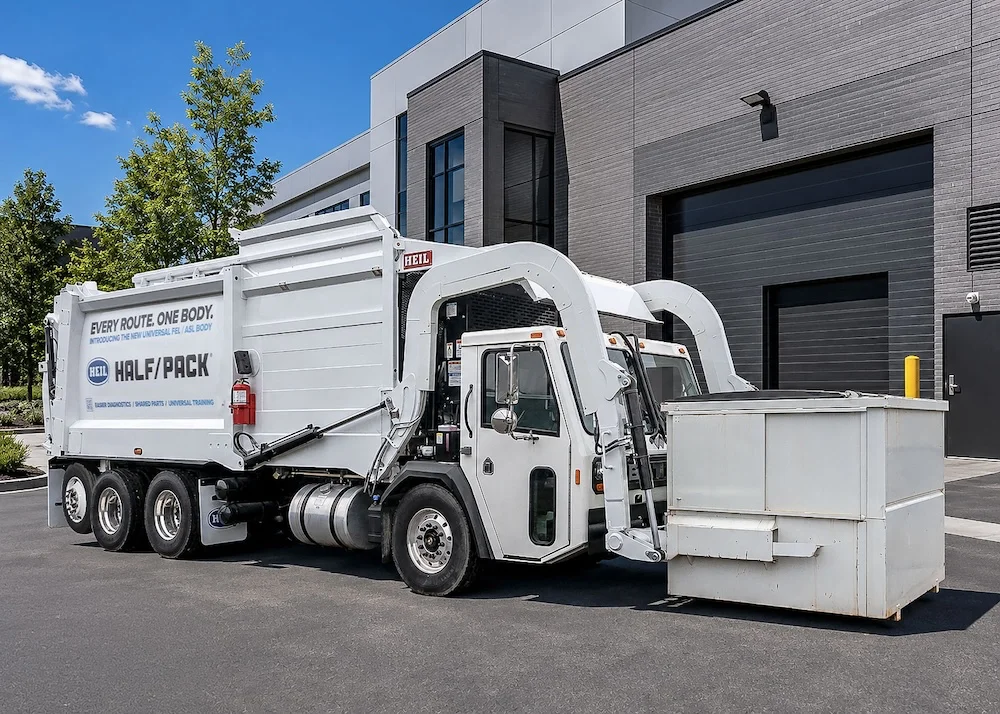
A front loader uses two hydraulic arms fitted with forks. The forks engage slots on a compatible commercial waste container.
The truck lifts the container over the cab and empties it into a hopper on top of the body. A hydraulic packer moves and compresses the material inside the body.
Front loaders primarily serve commercial and industrial routes with large, standardized dumpsters.
Best Applications for Front Loaders
Front loader garbage trucks are suitable for:
- Shopping centers
- Restaurants
- Hotels
- Office buildings
- Apartment complexes
- Factories
- Warehouses
- Large commercial properties
These sites often generate more waste than a standard residential cart can hold. A commercial dumpster allows the customer to store waste between scheduled collections.
Advantages of Front Loaders
One trained driver can usually complete the entire lifting and emptying process from the cab. This reduces manual container handling and supports efficient commercial routes.
Front loaders can collect a substantial amount of waste in one lift. The compaction system then reduces material volume, allowing the truck to serve more collection points before unloading.
They also provide predictable performance when every collection site uses compatible containers.
Front Loader Considerations
Front loaders need enough space above and around the container to complete the lifting cycle. Trees, power lines, roofs, balconies, signs, and enclosure structures may restrict access.
The site must also provide enough room for the truck to approach and align its forks with the dumpster. Buyers should evaluate container dimensions, fork pockets, enclosure layout, turning radius, and overhead clearance before choosing this configuration.
3. Side Loader Garbage Trucks
A side loader truck receives waste through an opening on the side of the body. Depending on the model, workers may load it manually or use a mechanical arm to lift standardized carts.

Side loaders fall into three main categories: manual, semi-automatic, and fully automated.
Manual Side Loaders
Manual side loaders have a side loading opening or hopper. Collection workers lift bags or empty containers into the truck by hand.
This configuration suits areas where carts are not standardized or where waste must be collected from multiple positions along a narrow route.
Semi-Automatic Side Loaders
A semi-automatic side loader uses a lifting mechanism, but a worker must move the cart to the lifter and position it correctly.
The lifter raises and empties the cart into the hopper. This reduces lifting effort while maintaining flexibility on routes where containers are not always placed in a consistent position.
Automated Side Loaders
An automated side loader uses a hydraulic arm controlled from inside the cab. The arm reaches toward a wheeled cart, grips it, lifts it, and empties it into the body.
The operator can complete the collection cycle without leaving the cab when carts are positioned correctly. This makes automated side loaders well suited to high-density residential routes with standardized containers.
Explore KAILI’s side loader trash trucks for residential, community, and municipal waste collection.
Advantages of Side Loaders
Automated side loaders can reduce crew size and limit repetitive manual lifting. They also support fast collection across routes with many closely spaced stops.
Keeping the operator inside the cab can reduce exposure to traffic, harsh weather, sharp objects, and direct contact with waste.
The side-loading design works especially well for curbside collection because the arm can reach containers placed beside the road.
Side Loader Considerations
Automated side loaders depend on consistent cart placement. Parked vehicles, utility poles, walls, trees, or incorrectly positioned carts can block the lifting arm.
The truck also needs enough lateral operating space. Route planners should evaluate street width, curb access, traffic direction, arm reach, collection side, and right- or left-hand-drive requirements.
4. Roll-Off Garbage Trucks
A roll-off truck carries a large detachable container on a tilting frame. In a cable system, a winch pulls the container onto the truck along a set of rails.
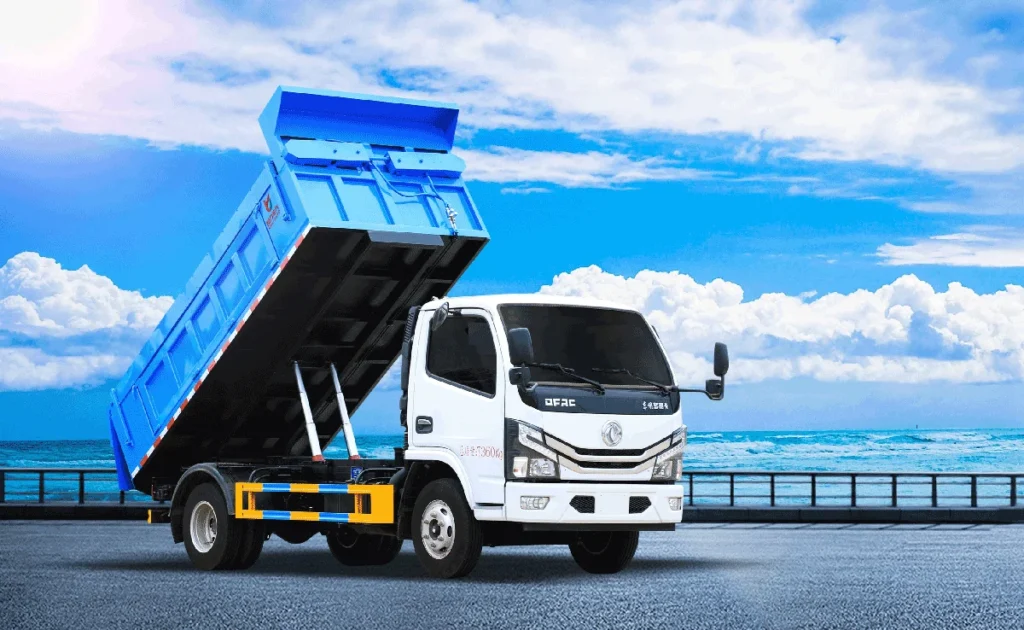
The driver transports the full container to a transfer station, landfill, recycling facility, or processing site. After unloading, the truck can return the container or replace it with an empty one.
Unlike conventional compactor trucks, a roll-off vehicle usually transports the entire container rather than emptying it into a fixed body.
Best Applications for Roll-Off Trucks
Roll-off trucks are commonly used for:
- Construction debris
- Demolition waste
- Industrial waste
- Scrap material
- Large commercial properties
- Factory cleanouts
- Renovation projects
- Recycling operations
- Bulky waste
- Temporary waste collection sites
View KAILI’s roll-off dump trucks for detachable-container waste transport applications.
Advantages of Roll-Off Trucks
A roll-off container can remain at a job site while workers fill it over several days or weeks. The truck only needs to return when the container is ready for transport.
Different container sizes can support different waste volumes and applications. Open-top containers work well for construction debris, while enclosed containers provide better containment for lightweight or loose material.
Roll-Off Truck Considerations
Loading and unloading require a stable surface and enough space behind the truck. Operators must also check overhead obstructions, ground slope, container compatibility, rail dimensions, and legal payload.
Roll-off systems are not designed for frequent curbside cart collection. They serve projects and facilities that generate large quantities of waste in one location.
5. Hook-Lift Garbage Trucks
A hook-lift truck uses a hydraulic arm with a hook. The hook connects to a lifting bar on the front of a compatible container and pulls the body onto the chassis.

The system can load, unload, and tip a range of interchangeable bodies. One truck may work with waste containers, dump bodies, flatbeds, water tanks, or other specialized units.
Hook-Lift vs. Cable Roll-Off
Hook-lift and cable roll-off systems perform similar container transport tasks, but they use different loading mechanisms.
| Feature | Hook-Lift System | Cable Roll-Off System |
| Connection method | Hydraulic hook engages a front lifting bar | Cable and winch pull the container |
| Container handling | Fast and controlled | Well suited to large, heavy containers |
| Operating space | Often better for restricted sites | Usually needs more loading distance |
| Body flexibility | Supports multiple interchangeable body types | Primarily supports roll-off containers |
| Container compatibility | Requires a matching hook and frame standard | Uses compatible rails and cable connections |
Hook-lift systems provide flexibility for fleets that need one chassis to perform several jobs. Cable roll-off systems remain a strong choice for heavy construction, demolition, and commercial waste containers.
Neither system is universally better. The right choice depends on container availability, lifting capacity, site conditions, operating speed, maintenance resources, and the types of contracts the fleet serves.
6. Specialized Garbage Truck Types
The main loader categories cover most municipal and commercial collection work. However, some routes require more specialized vehicles.
Split-Body Garbage Trucks
A split-body truck divides the waste body into two or more separate compartments. Each compartment holds a different waste stream.
A fleet may use a split-body truck to collect general waste and recyclables in one trip. Other configurations can collect recyclables and organic material without mixing them.
Split-body systems may use rear or side loading. They can reduce the number of vehicles required for multi-stream collection, but each compartment has less individual capacity than a single-compartment body.
Grapple Trucks
A grapple truck uses a hydraulic boom fitted with a grapple or clamshell attachment. The operator picks up large, loose, or irregular material and places it into a dump body or trailer.
Typical applications include:
- Tree branches
- Storm debris
- Furniture
- Large household items
- Illegal dumping cleanup
- Loose bulk waste
Grapple trucks handle material that workers cannot safely place into a standard hopper or cart.
Mini Garbage Trucks
Mini garbage trucks use a smaller chassis and waste body. They suit narrow streets, pedestrian districts, campuses, residential communities, tourist areas, and locations where a full-size refuse truck cannot maneuver safely.
These trucks may use rear, side, self-loading, or sealed dump bodies. Some fleets use them to collect waste from restricted areas before transferring it to a larger vehicle or local collection point.
Self-Loading Garbage Trucks
A self-loading garbage truck uses a hydraulic lifting mechanism to raise a standard bin or small container and empty it into the vehicle body.
These trucks often serve residential communities, public facilities, schools, commercial areas, and small municipal routes. Their compact size and mechanized loading system can reduce manual handling.
Sealed Garbage Dump Trucks
A sealed garbage dump truck uses an enclosed body to contain loose waste and wastewater during transport. The body tips or opens hydraulically at the disposal site.
This configuration does not always compact waste. Its main purpose is secure collection and transport with reduced leakage and material spillage.
Is a Garbage Compactor Truck a Separate Type?
“Garbage compactor truck” describes a function rather than a loading position.
Front loaders, rear loaders, and side loaders may all include compaction systems. The loading direction explains where waste enters the vehicle, while the compactor explains how the truck reduces the material’s volume.
A compaction mechanism can increase the amount of waste carried during a route. However, actual payload remains limited by the chassis rating, axle limits, waste density, and local regulations.
Not every waste stream should be heavily compacted. Bulky construction debris, certain recyclable materials, and hazardous items may require a different body or handling process.
Detachable containers can also include mobile compactors. In this arrangement, waste is compacted inside a sealed container before a roll-off or hook-lift truck transports the complete unit.
Learn more about KAILI mobile trash compactors for sites that need sealed waste storage and compaction.
Electric Garbage Trucks Are a Powertrain Category
An electric garbage truck is not a separate loading type. The vehicle may still use a front, rear, or side-loading body.
The term “electric” describes how the chassis and collection equipment receive power. Electric refuse trucks can reduce local exhaust emissions and operating noise, which may benefit early-morning residential collection and low-emission zones.
Fleet operators must still match the body to the route. They should also evaluate:
- Daily driving distance
- Number of collection stops
- Body and payload weight
- Hydraulic or electric equipment demand
- Charging time
- Available charging infrastructure
- Weather and terrain
- Reserve energy requirements
- Maintenance and technician training
A suitable electric truck must complete both the driving cycle and the loading cycles required during a full shift.
How to Choose the Right Type of Garbage Truck
The best garbage truck is the one that matches the actual collection system. Buyers should define the route and waste conditions before comparing models.
1. Identify the Waste Stream
Start by determining what the truck will collect:
- Household waste
- Commercial waste
- Recyclables
- Organic waste
- Construction debris
- Industrial waste
- Bulky waste
- Mixed municipal waste
Waste density and physical form affect body design, payload, compaction, corrosion protection, and discharge requirements.
2. Match the Truck to the Container System
Identify the containers already used across the service area.
Standard wheeled carts support automated side loaders. Large commercial dumpsters require compatible front-loader forks. Bags and irregular containers may favor a rear loader. Detachable bulk containers require a roll-off or hook-lift system.
Changing the truck without considering the existing container network can create compatibility problems across an entire route.
3. Evaluate the Collection Route
Inspect the operating environment rather than relying only on maps.
Important factors include:
- Road width
- Turning radius
- Alley access
- Traffic density
- Stop frequency
- Container spacing
- Road surface
- Ground slope
- Overhead clearance
- Parked vehicles
- Distance to the disposal facility
A high-capacity vehicle may reduce unloading trips, but it can perform poorly if it cannot safely enter the collection area.
4. Determine the Required Automation Level
Compare manual, semi-automatic, and fully automated collection.
Manual systems provide flexibility but may require more workers. Semi-automatic lifters reduce lifting effort while maintaining some route flexibility. Fully automated systems can reduce crew size, but they require compatible carts and consistent container placement.
Consider labor availability, route density, operator visibility, worker exposure, training, and collection speed.
5. Compare Body Volume, Payload, and Compaction
Body volume alone does not determine how much waste the truck can legally carry.
Buyers should compare:
- Nominal body volume
- Chassis gross vehicle weight rating
- Available legal payload
- Front and rear axle limits
- Waste density
- Compaction capability
- Hopper capacity
- Water tank or leachate capacity
- Unloading method
A larger body can add unnecessary weight if the truck reaches its payload limit before using the full volume.
6. Review Safety and Visibility
Garbage trucks operate near workers, pedestrians, cyclists, parked vehicles, and other traffic.
Useful safety features may include:
- Rear-view and side-view cameras
- Proximity sensors
- Audible warnings
- Emergency-stop controls
- High-visibility work lights
- Interlocks
- Body-up indicators
- In-cab loading controls
- Automatic container locks
- Anti-lock braking systems
The right safety configuration depends on the body type, route, crew arrangement, and local rules.
7. Calculate Total Cost of Ownership
Purchase price represents only part of the truck’s lifetime cost.
Evaluate:
- Fuel or electricity consumption
- Labor requirements
- Preventive maintenance
- Hydraulic system access
- Spare-parts availability
- Tire and brake wear
- Corrosion protection
- Expected downtime
- Operator and technician training
- Warranty
- Local service support
- Resale value
A truck with a higher initial cost may provide better value if it reduces crew requirements, route time, fuel use, or unscheduled repairs.
Which Garbage Truck Is Best for Each Application?
| Application | Recommended Truck Type |
| Standard residential curbside collection | Automated side loader |
| Residential routes with mixed containers | Rear loader |
| Commercial dumpsters | Front loader |
| Narrow streets and small communities | Mini rear loader, side loader, or self-loader |
| Construction and demolition waste | Roll-off or hook-lift truck |
| Bulky waste and tree branches | Grapple truck |
| Recycling and organic collection | Split-body truck |
| Industrial facilities | Front loader, roll-off, or hook-lift truck |
| Temporary waste collection sites | Roll-off or hook-lift truck |
| Sealed community waste storage | Mobile compactor with a compatible transport vehicle |
No single truck can provide the best performance across every application. Large municipal and private fleets often combine several body types so each route receives the right equipment.
Common Garbage Truck Selection Mistakes
Choosing by Body Volume Alone
A large body does not guarantee a higher usable payload. Dense waste may cause the truck to reach its weight limit before the body is full.
Ignoring Container Compatibility
The lifting system must match the carts, dumpsters, or detachable containers used by customers. Small dimensional differences can prevent safe operation.
Overlooking Route Access
A truck may have enough capacity but lack the turning radius, arm clearance, or overhead space required at collection points.
Assuming Maximum Automation Always Works Best
Automation can reduce labor, but standardized carts and predictable placement are essential. Mixed or irregular routes may need a more flexible loading system.
Neglecting Parts and Service Support
A productive truck provides little value when a failed component keeps it off the road. Buyers should review local parts availability, technician support, warranties, and maintenance access before ordering.
Final Thoughts
The main types of garbage trucks are rear loaders, front loaders, side loaders, and roll-off trucks. Hook-lift trucks, split-body vehicles, grapple trucks, mini collection trucks, and sealed waste vehicles serve more specialized roles.
The right choice depends on how the waste is stored, where the truck operates, how many stops it must complete, and how the material will be unloaded. Capacity matters, but route access, legal payload, automation, safety, maintenance, and lifetime operating cost matter just as much.
Frequently Asked Questions About Garbage Truck Types
What are the four main types of garbage trucks?
The four main types are rear loaders, front loaders, side loaders, and roll-off trucks. Rear, front, and side loaders describe where waste enters the body. Roll-off trucks transport complete detachable containers used for bulk, commercial, industrial, or construction waste.
What is the most common type of garbage truck?
The most common type depends on the collection system. Rear loaders remain common on flexible residential and mixed-waste routes. Automated side loaders are widely used for standardized curbside carts, while front loaders dominate many commercial dumpster routes.
What is the difference between a front loader and a rear loader?
A front loader uses hydraulic forks to lift large dumpsters over the cab. A rear loader receives waste through a hopper at the back. Front loaders suit standardized commercial containers, while rear loaders can handle bags, carts, loose refuse, and mixed routes.
Which garbage truck is best for residential collection?
An automated side loader works well for dense residential routes with standardized wheeled carts. A rear loader may perform better where residents use bags, different container sizes, or irregular collection points. Road width and crew availability also affect the decision.
What type of garbage truck collects commercial dumpsters?
Front loader garbage trucks commonly collect large commercial dumpsters. Hydraulic forks engage the container, lift it over the cab, and empty it into the hopper. Smaller commercial containers may also be serviced by rear loaders equipped with compatible lifting attachments.
Do all garbage trucks compact waste?
No. Many front, rear, and side loaders compact waste, but roll-off, hook-lift, sealed dump, and grapple trucks may transport material without compacting it. Compaction depends on the body configuration and the type of waste being collected.
What is the difference between a roll-off truck and a hook-lift truck?
A cable roll-off truck uses a winch and cable to pull a container onto rails. A hook-lift truck uses a hydraulic arm that connects to a lifting bar. Hook lifts support fast body changes, while cable systems often handle large, heavy containers.
How many workers operate a garbage truck?
Crew size depends on the loading system. Automated front and side loaders may use one driver. Manual or semi-automatic rear-loading routes may require a driver plus one or more collection workers. Local safety rules and route conditions can also affect staffing.
What is a split-body garbage truck?
A split-body garbage truck has two or more separate compartments. It can collect different waste streams, such as trash and recyclables, during one route without mixing them. The loading mechanism may be positioned at the side or rear.
Is a refuse truck the same as a garbage truck?
Yes, in most contexts. “Refuse truck,” “garbage truck,” “trash truck,” and “waste collection vehicle” often describe the same vehicle category. Regional language and industry usage determine which term appears most often.’
Have questions about a KAILION GARBAEG TRUCK?